
Seminar
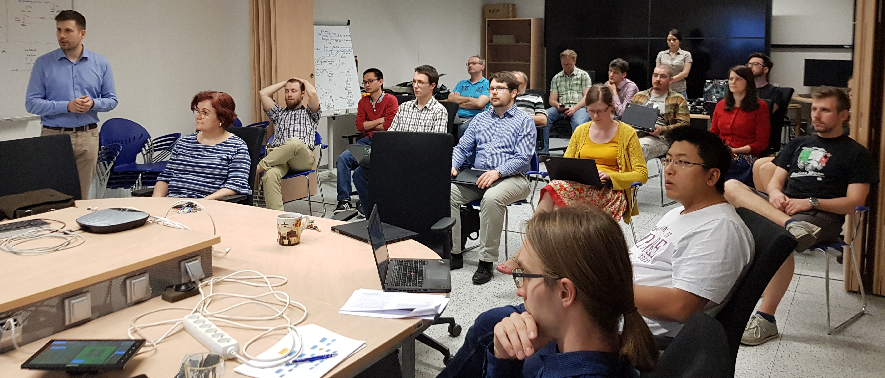
Laboratory seminars (PV273 in the course catalog) on Wednesday, 10:30 – 11:30, A505, FI MU, Botanická 68, followed by an informal group lunch.
The format of standard lectures: 30-40 minutes presentation + 15 minutes for questions. Slides are expected in English, and the presentation is in English or Czech, depending on the audience. For past seminars, go here.
- 16.9.2026
Estrella Fernandez-Gimenez, PhD
SBGrid: Research Computing Support for Structural Biology
Abstract: Modern structural biology depends on complex software ecosystems that are difficult to install, maintain, and reproduce, particularly for cryo-EM. The non-profit SBGrid Consortium supports over 500 laboratories in 22 countries by centrally maintaining and distributing more than 1,000 applications. SBGrid promotes sustainability and reproducibility through software “capsules” that bundle applications with their dependencies for consistent cross-platform use. Through the Instruct-SP partnership and collaboration with the JM Carazo laboratory, SBGrid has integrated Scipion plugins directly with its software capsules. This integration provides reproducible cryo-EM workflows, shared environments, coordinated training, and local support. SBGrid also has a cloud platform that enables computationally intensive workflows without extensive local infrastructure. It offers a proven model for scalable and sustainable structural biology computing across Europe. - 23.9.2026
RNDr. David Procházka, Mgr. Filip Jozefov, Mgr. Emma Sommerová, Bc. Boris Lukačovič
DreaMS Search: vector search over 200+ million tandem mass spectra
Abstract: Small molecules are central to biology and are an important source of medicines and other bioactive compounds. Yet the molecular structures of most small molecules observed in biological and environmental samples remain unknown. Tandem mass spectrometry is one of the main technologies used to study these molecules. Vast amounts of mass spectrometry data have been collected and shared through GNPS/MassIVE, a major public repository that now contains more than a billion spectra, most of them without an identified molecular structure. The recently introduced model DreaMS (Bushuiev et al., Nature Biotechnology, 2026) represents spectra so that their similarity reflects the chemical similarity of the molecules that produced them.
To make the power of DreaMS available to the community, we introduce DreaMS Search (dreams.fi.muni.cz), a large-scale similarity-search application that currently provides access to more than 200 million MS/MS spectra from GNPS/MassIVE. In this presentation, we describe the application: its architecture, the spectral data and metadata it indexes, the interface through which chemists explore search results, and how DreaMS is being extended beyond spectral search.
DreaMS Search is a joint effort of FI MUNI, IOCB Prague, CIIRC CTU, CESNET, and Seoul National University. - 30.9.2026
RNDr. Pavel Novák
Early malware detection from event sequences: From behavioral analysis to real-time decision-making
Abstract: Traditional malware detection often relies on known indicators of compromise or evaluates program behavior only after a sufficient amount of information has been collected. From the perspective of active system protection, however, a more important question arises: Can malicious behavior be recognized early enough, before the malware carries out its key activities?
This talk presents doctoral research focused on the early detection of malware using sequences of events that capture its behavior during execution. The core idea is not to evaluate individual events in isolation, but to continuously assess whether the behavior observed so far is more consistent with a benign or a malicious program. This results in a continuously updated decision process that may enable detection based on only a partial execution trace.
The talk will introduce the main principles of the proposed approach, the representation of program behavior, and its experimental evaluation using data obtained from dynamic malware analysis.
The results show that characteristic differences between benign and malicious behavior can already be observed at relatively early stages of program execution, and that strong detection performance does not necessarily require highly complex models. - 7.10.2026
Raheleh Abbasi
A newcomer’s perspective: Relocation, academic life, and my PhD journey in Czechia
Abstract: Moving to a new country involves much more than adapting to a new place; it also means becoming familiar with a different culture, academic environment, and way of everyday life. In this talk, I will share some of my personal experiences of relocating to Czechia and becoming part of the university and research environment as an international PhD student. I will reflect on aspects of the Czech academic and educational system that I found interesting, different, or unexpected from an external perspective, as well as the practical and cultural challenges of settling into a new country. I will also highlight aspects that I have particularly appreciated and share a few observations that may be useful when welcoming and supporting international students and researchers. Finally, I will briefly introduce my PhD project, its main goals and research direction, and my plans for the next stages of my PhD. - 14.10.2026
Sabine Rieder, M.Sc.
Towards explainable out-of-distribution detection and shielding
Abstract: To ensure the safe operation of neural networks (NNs) in safety-critical settings, different runtime monitoring techniques have been developed. Examples of such techniques include out-of-distribution detection, where the goal is to identify inputs that the NN was not trained for, and shielding in reinforcement learning, where the agent is prohibited from taking actions that lead to unsafe behavior.
While there is a vast body of literature, these techniques often do not explain their decisions. In this talk, after giving an introduction to out-of-distribution detection in the hidden space of a NN, I will present recent and ongoing work aimed at providing explainable out-of-distribution detection methods and shields. - 21.10.2026
Ing. Xenie Bobryšava
Sharing is caring? A longitudinal analysis of citation impact among researchers who publish data
Data are playing an increasingly prominent role in research, and proper research data management is becoming an inherent part of modern scientific practice. Introduced ten years ago, the FAIR principles provided a framework for making data findable, accessible, interoperable, and reusable, while Open Science, now widely adopted across the research landscape, has further reinforced the importance of responsible data management and sharing as part of high-quality research. This raises the question of whether researchers who engage in these practices also show different patterns of scientific impact over time.
In this talk, I will present ongoing research based on the hypothesis that researchers who publish datasets have different citation trajectories, and potentially higher citation impact, than researchers who do not. Using OpenAlex as the main source of open bibliographic metadata, the study follows researchers over the last ten years and compares the development of their citation impact over time.
I will introduce the motivation behind the study, the data and methodology used for the longitudinal analysis, and some of the practical advantages and limitations of working with open bibliographic sources such as OpenAlex. I will also discuss the limitations of commonly used citation-based research metrics and the extent to which they capture broader Open Science practices.
Finally, I will present preliminary results and discuss whether any systematic differences in citation trajectories can be observed between researchers who publish datasets and those who do not. - 4.11.2026
Ing. Matyáš Kroupa
TBA - 11.11.2026
Bc. René Češka
Hyfae: Decentralized social network with community-driven moderation
Modern social networks face two interconnected problems: centralization and disinformation. While decentralized alternatives address centralization, they consistently fail to combat disinformation effectively, limiting their adoption and creating communities vulnerable to manipulation. Removing centralized moderation without offering a distributed alternative for verification produces a vacuum, and disinformation fills vacuums quickly. No existing system combines decentralization with moderation its own users can trust.
This presentation introduces Hyfae, a decentralized social network designed to solve this problem. It uses a web of trust to determine whom a user trusts, and since we trust different people with different things, that trust is split into multiple dimensions (e.g., #tech, #politics). Built on top of this foundation are a distributed wiki acting as the network’s collective memory and a user-driven flagging system to filter harmful content and elevate information quality. The network therefore looks a little different for everyone, depending on their trusted connections. To the question of who decides what is true, the answer is the users themselves.
All of this runs on a hybrid architecture that combines Nostr relays with direct peer-to-peer exchange, merging the reliability and reach of federated systems with the resilience of pure P2P solutions. This ensures that content survives any single relay disappearing and that no one is forced to operate a server to take part. - 18.11.2026
Mgr. Adrián Rošinec
Ph.D. thesis rehearsal
TBA - 25.11.2026
Ing. Jan Krejza, Ph.D., Ing. Růžena Janoutová, Ph.D.
TBA - 2.12.2026
Ing. Kristián Kováč
TBA - 9.12.2026
TBA - 16.12.2026
Christmas@Sitola
Contact: Hana Rudová